
Beyond the Hype: How AI-Powered Telemedicine Is Redefining “Gold Standard” Care
The stethoscope and the in-person consultation are no longer the exclusive throne of medical diagnosis. Between 2024 and 2026, peer-reviewed medicine has crossed a digital Rubicon. We are no longer asking if AI and telemedicine work; we are measuring how much better they perform than traditional models.
At Synergy Medica Healthcare, we don’t just follow these trends—we analyze the raw data from The BMJ, The Annals of Plastic Surgery, Cureus, and Digital Health to implement the protocols that actually move the needle on mortality and quality of life.
Special Journal Insight I: The Death of the “Non-Emergent” Referral
Historically, rural patients were transferred to central hospitals “just in case.” This clogs ERs and delays care for true emergencies. The study analyzed an integrated multidisciplinary telehealth platform with AI-assisted ECG monitoring.
Non-emergent referral rates dropped from 30% to 10% within two years.
83% of stroke patients received thrombolytics within the “golden hour.”
At-home ECG monitoring caught Atrial Fibrillation in 25% of cryptogenic stroke patients within 2 weeks—preventing the next stroke.
“The integrated telehealth centre model provides a scalable and replicable approach for healthcare delivery.”
— Tu et al., BMJ Health Care Inform, 2025
For Synergy Medica Healthcare:
This isn’t a tech demo; it’s a survival metric. We prioritize 5G-ready ambulance coordination and smart monitoring to ensure that when a patient leaves our network, they are never outside the ICU-grade watchtower.
Special Journal Insight II: Wound Care Without the Windshield Time
Chronic wounds kill quality of life. The burden of driving to clinics weekly devastates caregivers. This RCT proved that AI can measure wound size, classify tissue, and flag deterioration automatically.
Healing rates were statistically similar between AI-telemedicine and conventional care (non-inferior).
BUT: Clinic visits were reduced by 59% (5.5 vs. 13.2 visits).
Caregiver quality of life improved by nearly double (FDLQI improvement 10.3 vs 5.7).
For Synergy Medica Healthcare:
“Best treatment” isn’t just the prescription pad—it’s preserving the patient’s dignity and the family’s sanity. We implement AI-assisted visual diagnostics to keep patients healing at home, not idling in waiting rooms.
Special Journal Insight III: The 99.1% Accuracy Triage Solution
Triage errors kill. The TeleMedQuick system utilized 76,229 clinical rules derived directly from emergency physicians and medical guidelines.
Triage errors kill. The TeleMedQuick system utilized 76,229 clinical rules derived directly from emergency physicians and medical guidelines.
"AI-driven models can detect subtle predictive trends, temporal patterns, and cross-parameter interactions that precede overt clinical decline. By shifting from reactive monitoring to anticipatory risk stratification, such approaches support earlier clinical intervention, personalized escalation pathways, and more efficient use of healthcare resources."
Dr. Suhail Chughtai, FRCS, FFLM (Clinical Director: Orthopaedics & Trauma, AI Division Head, UK Digital Health & Care) and Co-authors
Our Approach to Helping You Stay HealthyThe Synergy Medica Healthcare Difference: Closing the “Validation Gap”
If the technology exists and the data is peer-reviewed, why isn’t everyone doing this?
The 2025 review in Cureus identifies the bottleneck: “most studies remain limited in real-world validation” and face “regulatory inconsistencies” and “algorithmic bias”.
Similarly, the UAE qualitative study highlights that successful integration requires “full involvement and engagement of stakeholders across all stages of implementation” and “adequate training of the healthcare staff”.
This is where Synergy Medica Healthcare excels.
We don’t just purchase software; we execute clinical workflow integration. Our model ensures that:
- Data Privacy is maintained with ISO 27001-equivalent rigor.
- Physicians are trained to trust the AI’s differential, not fight it.
- Patients in remote or underserved grids receive the same diagnostic confidence as those in metropolitan tertiary centers.
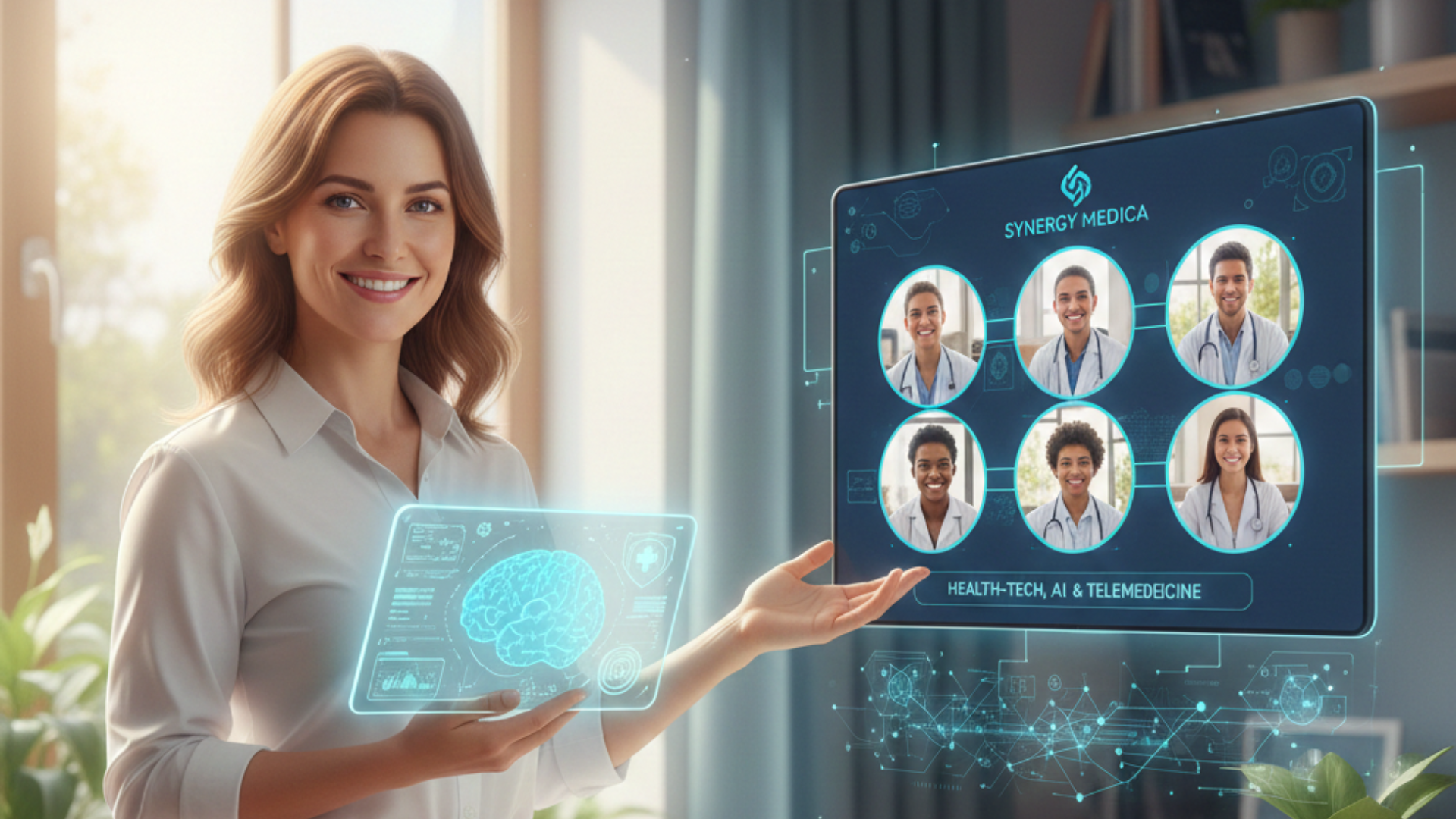
The journals are clear: AI and Telemedicine are no longer “alternative care.” They are superior care for specific, high-impact verticals—stroke, chronic disease, geriatrics, and triage.
Synergy Medica Healthcare is actively translating these 2024-2026 breakthroughs from PubMed abstracts into bedside reality. We are building the infrastructure that the BMJ calls “scalable and replicable,” and we are treating the health anxiety that Digital Health proved is just as vital as blood pressure.
The future of medicine is not in a single building. It is in the secure, intelligent, and empathetic connection between the patient and the provider. That connection is Synergy.